
SECAT™ is a Creative Arts Therapy assessment tool designed to be used with all client groups.
See how SECAT™ works, research which has informed it, and what it can provide for your practice.
What is SECAT™?
SECAT™ is a Creative Arts Therapy a functional assessment tool designed for Music, Art, and Drama therapists. It evaluates a client’s engagement through the lens of Relational Frame Theory (RFT), providing a visual formulation of their psychological flexibility. Unlike tools that simply checklist skills, SECAT™ measures the quality of the client’s connection to the creative process, making it particularly helpful for complex needs across the lifespan, from Trauma and Emotional Based School Avoidance, Learning Disabilities, and Dementia.
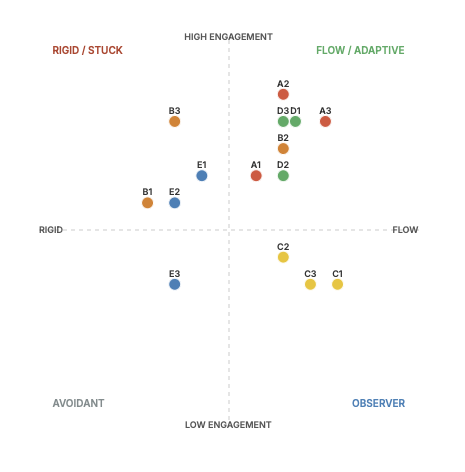
How does it work?
The SECAT™ Quadrant measures behavioural domains across both the quantity of engagement, as well as the functional relation of the behaviours and their function. The clinician rates five core domains, such as ‘Social Interaction’ and ‘Interaction with Media’ across two distinct axes:
The Engagement Scale (Y-Axis): Measures the observable ‘topography’ of the session - skill level, frequency of participation, and duration of play.
The Relational Flexibility Scale (X-Axis): Measures the ‘function’ of the behaviour - specifically, is the client Rigid/Stuck (0-3), Rule-Following/Compliant (4-6), or Adaptive and In Flow (7-10)? These scores are plotted on a quadrant graph, creating an instant visual snapshot that helps the Multi-Disciplinary Team distinguish between genuine progress, and masked anxiety.
Why is SECAT™ different?
Most creative arts assessments operate on the assumption that “more engagement is better.” SECAT™ recognises that high engagement can sometimes be a sign of anxiety-driven perfectionism, “fawning,” or rigid compliance. By separating Engagement from Flexibility, SECAT™ allows therapists to identify clients who are “High Performing, but Psychologically Stuck” (High Engagement, Low Flexibility) versus those who are “Quietly Observing (Low Engagement/High Flexibility). This nuance prevents misunderstandings and allows for precise, functionally-driven goal setting that targets an underlying mechanism of change rather than just surface-level behaviours.
Research that has informed SECAT™
-
"musical functioning is understood broadly as reflections of one's overall cognitive and affective relationship to the world and oneself" - Carpente & Aigen, 2015, p. 250
-
"are there generic assessments that could be applied to any population or setting?" - Gant, 2000, p. 42
-
"music therapists are often part of a multidiscplinary team, they... must engage in EBP to inform their clinical decisions" - Baker ed. Wheeler, 2017, p. 103
-
"Without science, therapy can degenerate to the practice of superstitious ritual, in which each practitioner owes allegiance only to his or her personal myth of existence. Without art, it can lose the very humanity it seeks to examine" - Lipe ed. Wheeler, 2017, p. 76
-
"there has always come a point with a [client] when a connection has been made that needs acknowledgement, which... can lead to a kind of knowing which may move the therapy on." - Levinge, 2015, p. 164
-
"using integrative knowledge from music, medicine, psychology, anthropology, and special education, as needed, the therapist has to consider whether the patient is suitable for this modality and determine the most appropriate directions, goals, methods, approaches, techniques, etc." - Sekeles, 1999, p. 181